Cookware Thermal Dynamics: How Material Affects Stove Performance
By Tenzin Dorje • 28th Apr
When you're planning a cold-weather trip or organizing a multi-day expedition, stove-cookware heat transfer matters as much as fuel choice does. Material thermal dynamics (how quickly a pot conducts heat, how evenly it distributes it, and how long it holds that heat) directly shapes your fuel consumption, meal reliability, and whether your system survives wind, altitude, or subzero conditions. This article cuts through vendor marketing to show you exactly how cookware material affects stove performance, and how to match pot to stove to your actual route.
Why Thermal Conductivity Is Not the Whole Story
Q: Isn't copper the "best" cookware material because it has the highest thermal conductivity?
Not necessarily. Thermal conductivity (the speed at which a material absorbs and releases heat) is measured in watts per meter per Kelvin (W/m·K).[1] For a deeper field primer on conduction, convection, and radiation in camp kitchens, see our stove heat physics guide. Copper, at 385 W/(m·K), is approximately twice that of aluminum (205 W/(m·K)) and eight times faster than stainless steel (45 W/(m·K)).[1] That raw number tempts you to believe copper is ideal for all cooking, but it ignores a second, equally critical property: thermal capacity (how much heat a material can store and distribute within itself before moving that heat to food).
This distinction is not academic. In field conditions (wind, cold, unstable ground, limited fuel), thermal capacity often matters more than raw conductivity. A material that rushes heat into food quickly may also dump it just as fast when ambient temperature drops, creating hot spots instead of even cooking. A clay-based ceramic pot, for example, conducts heat roughly 500 times slower than copper but can store three to four times more heat within its walls once heated.[3] That thermal inertia becomes a feature, not a flaw, when you're simmering stew on a compact liquid-fuel stove in mountain wind.
Which Materials Perform Best in Different Scenarios?
Q: What's the right cookware material for my camping stove?
That depends on your stove type, temperature range, and what you're actually cooking.
Aluminum: High Conductivity, Rapid Response
Aluminum cooking efficiency remains the mainstream choice because the trade-off is sensible.[1] Aluminum heats up quickly and cools down just as fast, which is ideal for boiling water or pasta on a canister stove in mild conditions. Its thermal conductivity (205 W/(m·K)) means a thin aluminum pot reaches temperature with minimal fuel overhead.[1] For solo backpackers prioritizing weight and speed-of-boil, aluminum paired with a piezo-ignition canister stove is a logical pairing.
The catch: pure aluminum can leach into acidic foods (tomato-based meals, citrus), and unclad aluminum pots often have poor simmer control. Most serious overlanding and group kitchens use aluminum pots with a stainless-steel base layer (cladding) to gain a non-reactive cooking surface while retaining heat speed.[1]
Risk note: Aluminum loses structural integrity at prolonged temperatures above 250 °C.[4] If you're using a high-output liquid-fuel stove on a large aluminum pot, monitor heat aggressively to avoid warping or coating failure.
Stainless Steel: Trade-Off for Durability
Stainless steel thermal conductivity is intentionally low (45 W/(m·K)), and that's by design, it is non-reactive and bulletproof in rough handling.[1] Unclad stainless steel cookware alone performs poorly in camps: cold spots, slow boils, and uneven temperature distribution plague basic stainless models. This is why nearly all quality stainless-steel cookware incorporates an aluminum or copper core or bottom layer.[1]
For expedition kitchens and group-camp setups, a stainless steel pan with a thick aluminum core is worth the weight. Simmer is controllable, acidic foods won't react, and the pot survives regulator flare-ups or being dropped on rocky ground.
Risk note: Bare stainless steel on a high-output flame will develop scorch patterns and hot spots. Pair it with windscreens and lower-intensity burners.
Cast Iron: Thermal Inertia in Cold Conditions
Cast iron camping performance hinges on understanding thermal mass. Cast iron conducts heat roughly 80 W/(m/K) (slower than aluminum), but its exceptional thermal capacity allows it to absorb and then slowly, evenly distribute enormous quantities of heat.[3] Once a cast-iron skillet reaches temperature on your camp stove, it maintains even heat across the entire cooking surface, making it unmatched for bread, pancakes, or seared meat.
In cold or windy camps, this becomes a real advantage. The iron holds its temperature longer when ambient conditions drop, reducing fuel "wasted" to reheating. A team at minus twenty needed liters of water by dawn; while others fought regulator freeze and erratic heat, we had fuel budget to spare because a cast-iron kettle on a primed liquid-fuel stove retained heat long enough to brew morale after melting snow. That margin wasn't luxury (it was safety), and we had enough fuel to do it twice if the first batch fell through.
Mitigation: Cast iron is heavy and requires field seasoning maintenance. Pre-season thoroughly before trips, and pack a small oil rag. For alpine or winter travel below 15 pounds of base weight, cast iron is often impractical; reserve it for car-camp and overlanding kitchens.
Ceramic Cookware: Even Heating and Heat Retention
Ceramic heat distribution relies on the material's inherently low thermal conductivity (0.15-1.8 W/(m·K)), which slows heat transfer across the vessel but distributes it remarkably evenly.[2][3] Once ceramic reaches the target temperature, it excels at retaining that heat due to its insulating properties.[2] For slow-cooking stews, soups, or sauces (common expedition meals), ceramic's thermal inertia is a genuine asset.
The downside is temperature sensitivity. Rapid heating and cooling, or sudden exposure to cold (water on a hot pot), can cause thermal shock and cracking.[6] Some ceramic pieces with low tensile strength are more prone to fracture than others, depending on composition and tempering.[6] In backcountry use, a ceramic pot is a luxury item, not a workhorse.
Risk note: Never rinse a hot ceramic pot with cold water. Allow cooling time. Protect the regulator from wind so your flame stays stable and you don't overheat the pot unnecessarily.
The Fuel-Consumption Trade-Off: Conductivity vs. Real-World Efficiency
Q: Does a higher-conductivity pot actually save me fuel on a multi-day trip?
Not always, and this is where skepticism pays off. A high-conductivity pot (aluminum, copper) boils water faster, which appears more efficient. But once food reaches target temperature, rapid heat-loss becomes a liability in wind or cold. You'll spend fuel re-heating as the pot dumps heat into the frigid air. Pairing your setup with heat-exchanger pots can further cut fuel use by improving pot-side efficiency in wind and cold.
Conversely, a cast-iron or ceramic pot takes longer to boil but then holds that heat, requiring less secondary fuel to maintain simmer temperature. Over a three-day trip with six people and multiple re-heats, the "slower" pot may deliver better fuel economy and more consistent meal outcomes.
The real efficiency gain comes from matching pot material to stove type and weather profile:
- Canister stove + aluminum pot + shelter from wind → Fast boil, acceptable if meals are simple (rehydrated, one-pot).
- Liquid-fuel remote canister stove + cast-iron pot + windscreen → Slower boil, stable simmer, excellent for groups and real cooking.
- Group stove (propane basecamp) + large aluminum core + hood or windscreen → Fastest boils, lowest fuel per meal when cooking for 4-8 people.
Cold punishes mistakes; redundancy and priming keep kitchens alive. Choose your pot material based on your stove type and conditions, not marketing hype about "best" thermal conductivity.
Practical Guidance: Choosing Cookware for Your Route
Q: How do I actually pick a pot for my next trip?
- Define your stove type and fuel. Integrated canister stove, remote-canister liquid-fuel, propane basecamp? Each burns at different intensities and requires different pot profiles. If you’re undecided on fuel technology, start with our canister vs liquid fuel comparison. Aluminum matches fast-boil scenarios; cast iron suits sustained simmering.
- Map your temperature range and wind exposure. Multi-day alpine winter trip? Thermal capacity (cast iron, ceramic) outweighs conductivity. Car-camp in mild seasons? Aluminum or aluminum-core stainless saves weight and boils faster.
- Validate for thermal shock risk. If your route involves rapid temperature swings (boiling water at altitude, then cooling in subzero air), avoid untempered ceramics or thin-walled glass. Stick to metals or borosilicate if you must use ceramic or glass.
- Test your complete system before departure. Stove + pot + fuel type + expected wind and cold. Simmer control, heat distribution, and regulator stability matter far more than any single material property. If your regulator struggles or the pot tilts on uneven ground, no thermal conductivity number will save your meal.
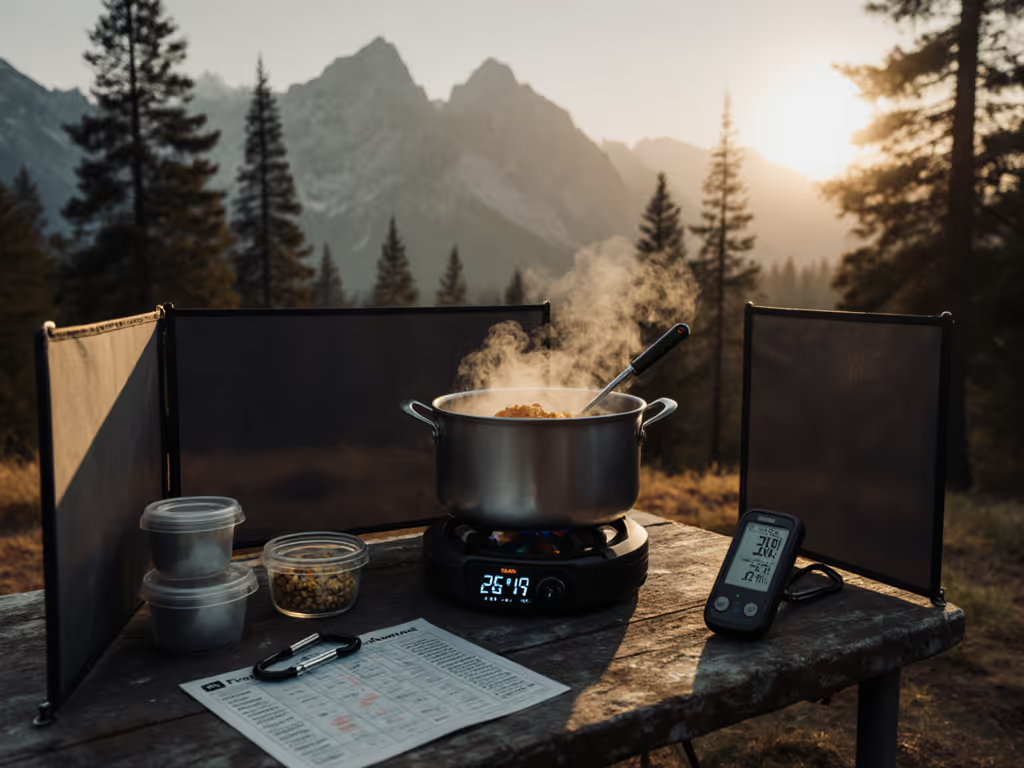
- Protect the regulator from wind. Use a purpose-built windscreen or stake a shelter around your stove. Understanding how pressure regulators stabilize flame output helps you diagnose sputters before they waste fuel. A consistent flame, regardless of cookware material, is your first defense against fuel waste and cold-condition failure.
Your Next Step: Map Your System
Take your planned route, weather forecast, group size, and meal list. Write down your stove type and fuel. Then ask: Do I need a fast boil (aluminum, copper core), or is even, sustained heat more valuable (cast iron, ceramic)? Cross-reference your answer against thermal conductivity and thermal capacity data, not marketing claims. For material-by-stove pairing tips, bookmark our cookware-stove efficiency guide.
Once you've chosen a pot material that matches your stove and conditions, run a field trial in a controlled environment (your backyard in cold weather, if possible) before committing to a multi-day trip. Field-test your complete system: fuel type, pot, windscreen, ignition, simmer control, and stability on uneven ground. That is not overcaution; it is the margin between a reliable kitchen and a trip where meals become a source of stress instead of morale.
In winter, the safest stove is the one you can operate flawlessly. In all seasons, the best cookware is the material that matches your stove, your route, and your real skill with fire.
Related Articles