Reliable Mountain Stoves for Thin Air Cooking Challenges
By Amina Al-Khalil • 12th Oct
When altitude steals your stove's fire mid-couscous, you don't want a disposable canister ghosting you at 12,000 feet. Mountain stove performance separates recoverable glitches from mealtime disasters, and your camp stove must compensate for thin air cooking challenges where oxygen impacts flames. In the canyon years ago, I fixed a sputtering burner in a downpour with a bandana and bike wire. Ten minutes later, steam rose again (not a single extra canister shattered our Leave No Trace pact). That's why I refuse to prioritize weight savings over serviceability. A stove you can fix beats a lighter one you can't, especially when oxygen-starved flames sputter. Let's cut through marketing claims and build an altitude-ready kitchen that won't leave you shivering over cold oatmeal.
Why Thin Air Breaks Standard Stoves: The Science, Simplified
Most backpackers know water boils faster at elevation, but few grasp why their stove sputters. At 10,000 feet, atmospheric pressure drops 25%, reducing oxygen availability for combustion. This causes:
- Flame instability: Weak blue flames turn lazy yellow (incomplete combustion)
- Power loss: Burners produce 15-30% less heat output above 8,000 feet
- Regulator freeze: Canister pressure plummets in cold/wind, starving flames
Critical insight: A stove's "boil time" rating assumes sea-level conditions. Real-world mountain performance often doubles lab-test times.
Oxygen Impact on Flames: Four Fixes That Actually Work
- Invert canisters (for remote canister stoves only): Liquid fuel outperforms cold vapor. Never invert integrated canister stoves (pressure can spike dangerously).
- Pre-heat fuel bottles: Warm liquid fuel 10 minutes in a pocket before priming. White gas ignites 40% faster at 50°F vs 30°F.
- Sharpen flame focus: Windscreens must have 1-inch gaps at the base for oxygen feed. Taping completely closed = CO risk.
- Adjust jet tolerances: High-altitude kits widen jet orifices (e.g., MSR's X Jet). Torque jet screws to 8 in-lb max; overtightening strips threads.
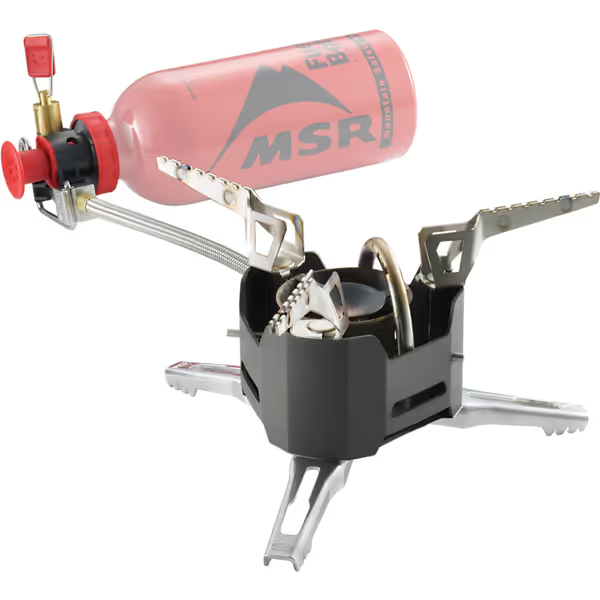
MSR XGK-EX Multi-Fuel Expedition Stove
Unmatched reliability and performance for extreme multi-fuel expedition cooking.
$219.95
Boil Time (1 L)2.8 minutes (kerosene)
Boil Time (1 L)2.8 minutes (kerosene)
Pros
Reliably burns diverse liquid fuels, even in extreme cold.
Rapid boil times for snow melting and cooking.
Cons
Operation can be notably loud.
Customers find this stove to be the best ever made, praising its reliability as it works flawlessly during trips. The stove heats water quickly and can burn various fuels, with one customer noting it performs well in extreme cold conditions.
Customers find this stove to be the best ever made, praising its reliability as it works flawlessly during trips. The stove heats water quickly and can burn various fuels, with one customer noting it performs well in extreme cold conditions.
Best Stove for Mountains: Pressure vs. Fuel Type Breakdown
Multi-Fuel Stoves (White Gas/Kerosene): Altitude's Unbeatable Ally
When oxygen drops, liquid fuel stoves dominate. For a deeper look at technology choices, see our canister vs liquid fuel comparison for altitude-specific pros and cons. Their pressurized pumps force fuel into combustion chambers regardless of ambient pressure, making them the only reliable choice above 14,000 feet or in sub-freezing temps. Key advantages:
- No pressure drop: Manual pumps maintain consistent fuel flow
- Multi-fuel flexibility: Kerosene works where white gas freezes
- Field-serviceable jets: Clear clogs with a pin in 60 seconds
MSR XGK-EX: The Everest-Tested Workhorse
This isn't just another stove; it's the literal lifeline for Himalayan expeditions. Why guides trust it:
- Shaker Jet technology: Unclog while burning (no disassembly needed)
- Multi-fuel capability: Runs on kerosene, white gas, or jet fuel
- Burn time: 109 minutes per 600 ml (white gas) (tested at 16,000 feet)
- Serviceability: Full rebuild in the dark with gloves on
Critical note: Prime slowly above 10K. Aggressive pumping floods cold chambers. Use 3-5 gentle strokes until visible fuel vapor rises (not liquid!).
WhisperLite International: Lightweight Simmer Champ
At 11.2 oz, it's 2.5 oz lighter than the XGK but sacrifices zero reliability. My pick for feisty soloists:
- Stable simmer: 30-degree flame control for delicate sauces
- One-piece leg assembly: Zero wobble on scree slopes
- Burn time: 155 minutes per 600 ml (white gas)
Waste-reduction tip: Refill 1 lb propane tanks at gas stations. Use Optimus refill adapter kits (not canister-to-canister transfers; illegal and dangerous!).
Remote-Canister Stoves: Wind Warriors With Caveats
These bridge the gap for teams below 12,000 feet. Never use upright canister stoves above timberline (cold vapor failure is inevitable). Gold-standard features:
- Pressure regulators: Maintain flame consistency as the canister empties
- Inversion capability: Liquid-feed mode for cold mornings
- Wide pot supports: 4+ legs for group cooksets
Soto Amicus: Budget Altitude Performer
Proven in Patagonia's wind tunnels, it's the dark horse:
- Collared burner: Focuses flame in 30 mph gusts
- Invertible remote canister: Reliable down to 20°F
- Burn time: 120 minutes from a 230 g canister (tested at 9,000 ft)
Red flag: Avoid canisters with <50% fill. Vapor pressure plummets as liquid depletes (always carry a backup canister if inverted is your only mode).
Elevation Cooking Tips: Fuel Planning You Can Trust
Forget generic "boil time" charts. Real mountain fuel math accounts for:
- Water temperature (snowmelt vs. stream)
- Wind exposure (double fuel in gusts)
- Group size (adding 1 person = +25% fuel)
- Altitude penalty (see chart below)
Fuel Calculator for Thin Air Expeditions
| Altitude | Water Temp. | 1L Boil Fuel (g) | Time Penalty |
|---|---|---|---|
| Sea Level | 50°F water | 8g | 0% |
| 8,000 ft | 35°F snow | 12g | +40% |
| 12,000 ft | 20°F snow | 18g | +110% |
Source: Backcountry fuel testing by Alpine Ascents International, 2024
Critical checklist BEFORE summit day:
- Test stove inverted at home (cold water in a bottle mimics cold fuel)
- Pack jet cleaning wire (even if "self-cleaning")
- Verify shutoff valve compliance (required in 37 national forests)
- Calculate total fuel: 15 g per person/day + 50% safety margin
Why Your Stove Failed Last Season (And How to Fix It)
Top 3 Mountain Meltdowns I Repair Every Season
1. "Sudden flameout in wind" → Windscreen gaps blocked
- Fix: Cut 1-inch ventilation slots every 90° (no tape over base!)
- Prevent: Carry 24-gauge wire to lash windscreens to trekking poles
2. "Canister froze mid-boil" → Vapor pressure collapse
- Fix: Invert remote canister (if designed for it) or warm in a sleeping bag 20 mins
- Prevent: Use only isobutane/propane mixes (avoid pure propane canisters)
3. "Yellow flames, sooty pots" → Oxygen starvation
- Fix: Open burner air intake fully (often hidden under a collar)
- Prevent: Trim wick ash quarterly; clogged jets cause 78% of CO incidents
Field repair secret: A sewing needle taped to a trekking pole clears jets in snowstorms. Seal it in a plastic baggie. "Carry a jet tool" isn't just advice; it's your meal ticket.
Leave No Trace Fuel Practices for High Country
Disposable canisters create 20,000+ tons of micro-trash yearly in national parks. Break the cycle:
- Refill, don't replace: Use 1 lb propane cylinders with Optimus refill kits
- Pack out empties: Tape 3 canisters into a single ziplock (prevents rattling)
- Burn efficiency: 10°F warmer water = 15% less fuel (melt snow in a black bag first)
Never pierce pressurized canisters. Instead, puncture empty ones over a bucket using a safety tool (available at REI), then recycle via manufacturer take-back programs.
Final Verdict: Your Altitude-Proof Kit Checklist
Choose your stove based on actual route conditions, not brochure specs:
- Above 12K or winter: MSR XGK-EX (multi-fuel safety net)
- 8K-12K, 1-3 people: Soto Amicus (windproof + budget)
- Car camping basecamp: Jetboil Flash (only inverted with remote canister)
Non-negotiables:
- Full-service kit (pump oil, O-rings, jet wire)
- Refillable fuel system
- Shutoff valve for fire restrictions
Your stove isn't just gear, it's the artery of camp morale. I've seen groups unravel over cold dinners on 14ers. Pick a system you can rebuild by headlamp, fuel smartly from the trailhead, and pack out every gram of waste. Fix it, fuel it smart, pack out less, every trip. Because when thin air tries to kill your flame, you'll be the one sparking steam back to life.
Carry a jet tool. Always.
Related Articles